European self-advocates come together for international Youth Exchange in Madrid
20 July 2026
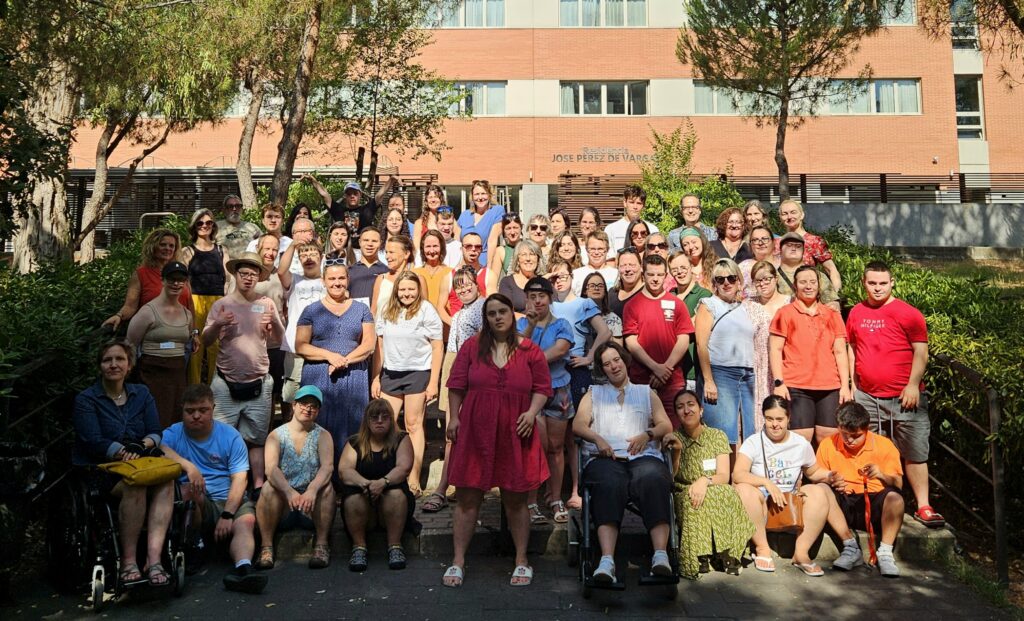 Madrid, 11 July 2026 – Fifty-five participants from ten European countries came together in Madrid from 5 to 11 July for the Together for Inclusion Self-Advocacy Youth Exchange. Hosted by Rey Juan Carlos University, the week brought together self-advocates with intellectual disabilities, trainers, supporters and translators to learn from one another, share experiences and discuss how inclusion can be strengthened across Europe.
The Youth Exchange was organised as part of Together for Inclusion: Fostering Self-Advocacy Across Europe, an Erasmus+ project coordinated by EU for Trisomy 21. The project supports people with Down syndrome and other intellectual disabilities to speak up for themselves, stand up for their rights and participate actively in their communities and in European public life.
Throughout the week, participants took part in eight workshops covering human dignity, communication, education, employment, independent living, political participation, health, and self-advocacy and rights. Each workshop was prepared and led by one of the participating country groups, giving self-advocates an active role in shaping and delivering the programme.
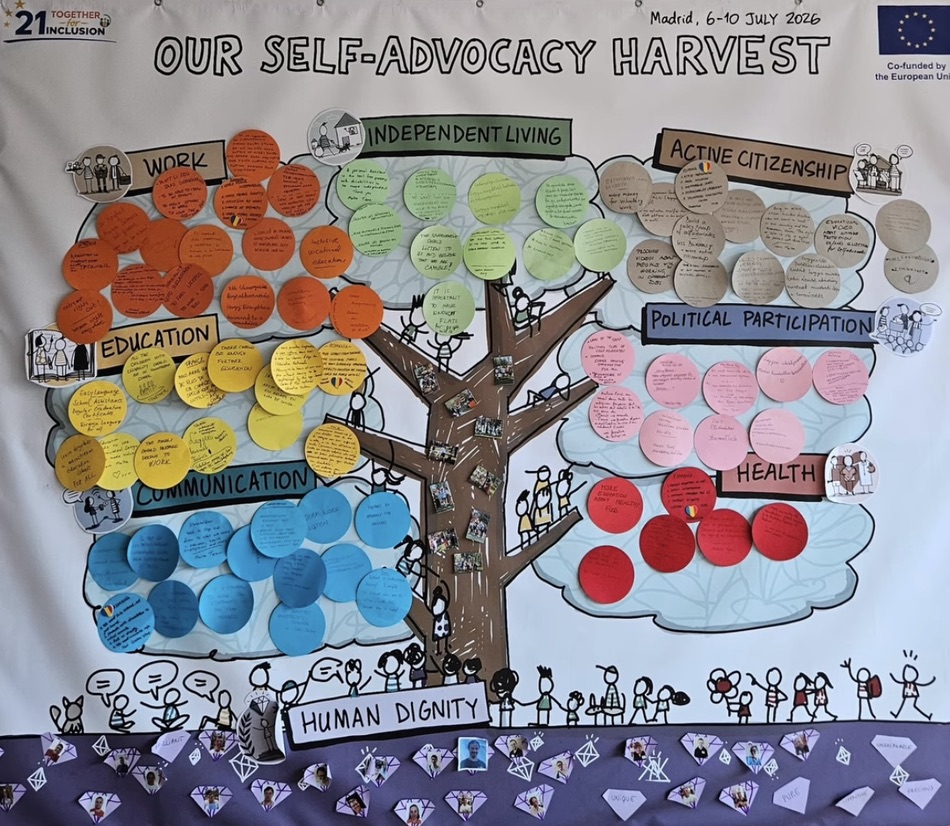
The Tree of Dignity (drawn by Marina Roa) grew throughout the week as participants added their most important messages, ideas and demands after each workshop. Each fruit represents the voice of a participating country group.
The workshops used discussions, role plays, games, creative activities and small-group work to make the topics accessible and encourage everyone to participate. With many different languages spoken during the week, translation and peer support played an essential role in ensuring that every participant could contribute.
At the centre of the exchange was the Tree of Dignity, which was drawn by Graphic Facilitator Marina Roa with Visual Thinking. After each workshop, the country groups reflected on what they had learned and wrote their most important messages, ideas and demands on paper fruits, which were then added to the tree. By the end of the week, the tree had become a visible record of the participants’ shared experiences and priorities.
The programme also took participants beyond the university. During a visit to the Jérôme Lejeune Foundation near Plaza Mayor, the group took part in the final workshop of the exchange and learned more about the Foundation’s work.
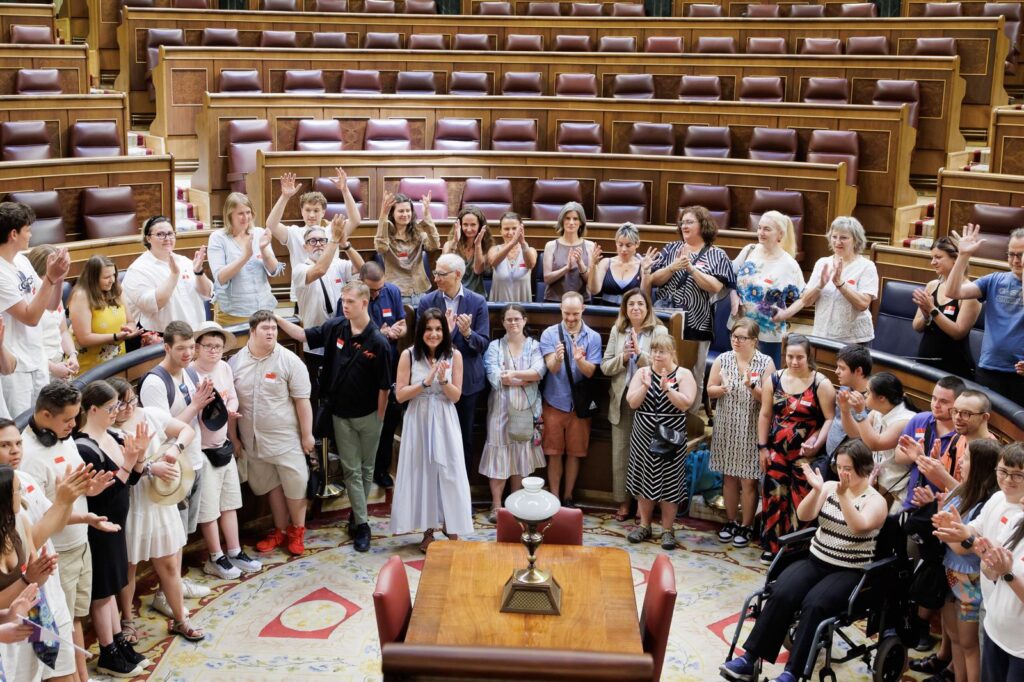 On Friday, the Youth Exchange concluded with a visit to the Spanish Congress of Deputies. The group was welcomed by parliamentarians Sandra Moreno and Francisco Conde, giving participants the opportunity to experience a national democratic institution and bring the week’s discussions on political participation and representation into a real political setting.
The results gathered during the Youth Exchange will now be documented and shared with the participating country groups. They will use these outcomes to develop national policy recommendations for local decision-makers. A version of the recommendations will also be submitted to the European Commission in November and will help prepare the self-advocates for the project’s work with political representatives in Brussels in 2027.
The Madrid Youth Exchange showed what meaningful participation can look like: people with intellectual disabilities speaking for themselves, learning across borders and contributing directly to the decisions and policies that affect their lives.
Together for Inclusion: Fostering Self-Advocacy Across Europe brings together partner organisations from Belgium, Czechia, France, Germany, Hungary, Italy, Malta, Poland, Romania and Spain. The project is co-funded by the European Union through the Erasmus+ programme.